Gerstäcker
Gerstäcker, the village carrier, is a minor but recurring figure in Franz Kafka's The Castle, whose brief appearances frame K.'s arrival and departure. He is defined by his physical frailty, his taciturn and self-interested manner, and his ultimate, unexplained reliance on K. His role shifts from a reluctant helper to a persistent claimant on K.'s influence, making him a quiet barometer of K.'s fluctuating status in the village.
Identity and First Encounter
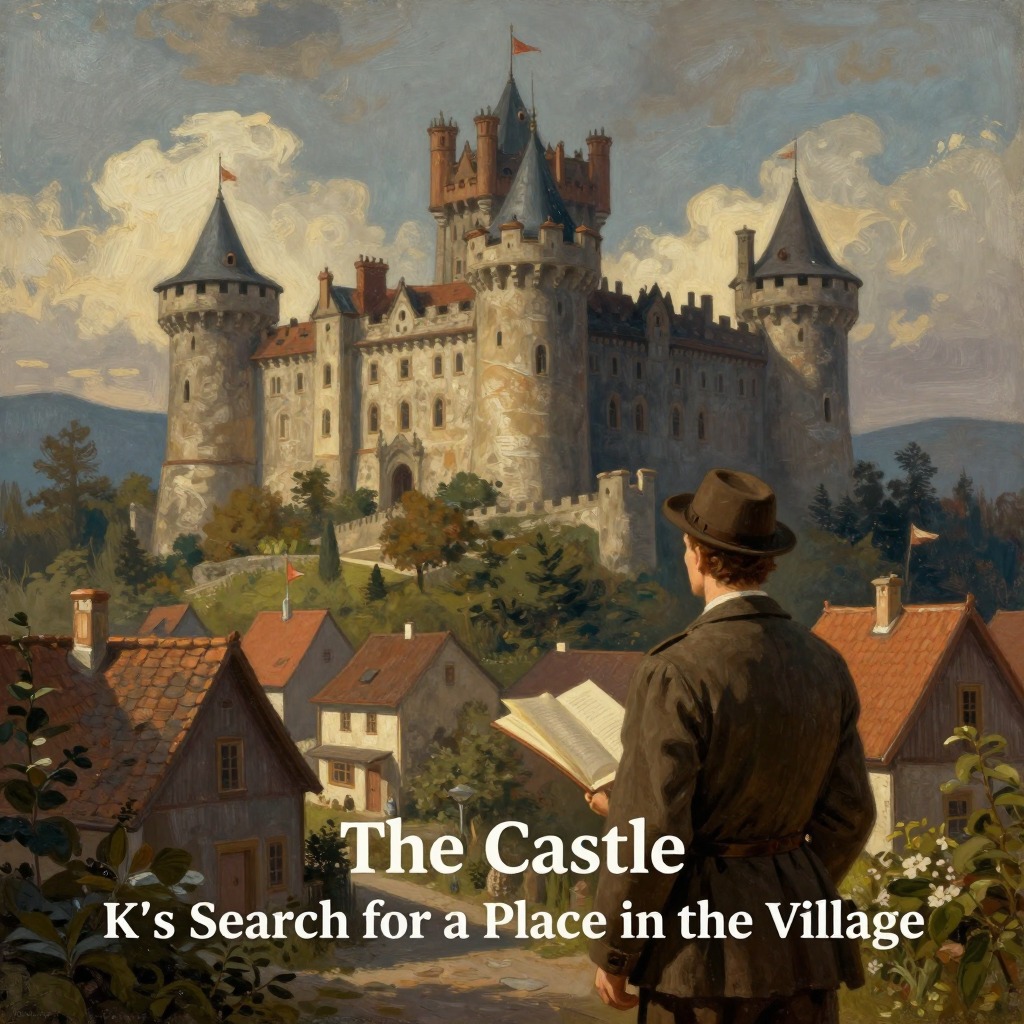
Gerstäcker first appears on K.'s first morning in the village, when K., exhausted and lost in the deep snow, is standing outside a cottage. Gerstäcker, who is not old but seems feeble, stooped, and limping, with a red face as if from a cold and a tightly wrapped woollen scarf, offers K. a ride in his small, flat-bottomed sleigh. The sleigh is for carrying light loads, has no seat, and is drawn by a feeble little horse. Gerstäcker insists on walking beside the horse, and when K. asks why, he simply repeats, "I'm going to walk," before succumbing to a fit of coughing that shakes him so badly he must brace his legs in the snow. He initially refuses payment, explaining, "Well, you're the land surveyor, and you belong at the castle," but when K. asks to be taken to the castle, Gerstäcker refuses, saying only, "Maybe," coldly. He agrees to take K. to the inn instead, and his manner throughout is described as "self-interested, anxious, pettily meticulous," suggesting his primary motive is to get K. away from his house.
The Sleigh Ride and Its Implications
During the ride, K. is struck by the castle's retreating into the distance and the sound of its bells. He asks Gerstäcker if it is allowed for him to drive K. on his own responsibility, and when Gerstäcker takes no notice, K. throws a snowball that hits him on the ear. Gerstäcker stops and turns, and K., seeing his bent form, his red, narrow face with lopsided cheeks, and his almost toothless mouth, repeats his question with compassion, asking whether Gerstäcker might be punished for giving him a lift. Gerstäcker replies blankly, "What are you getting at?" and then calls to the little horse and they move on. This exchange reveals Gerstäcker's awareness of the village's strict rules and his own precarious position, as well as K.'s growing sense of the arbitrary power that governs the village.
Later Encounters and the Final Offer
Gerstäcker reappears at the end of the novel, after K. has been expelled from the Castle Inn for lingering in the corridor. He is among the men waiting outside the inn for Erlanger, and he greets K. with the words, "So you're still in the village, are you?" When K. replies that he is there indefinitely, Gerstäcker says, "Well, that's nothing to do with me," before turning away. Later, after K.'s conversation with the landlady about her dresses, Gerstäcker is waiting in the hall, and he insists on taking K. with him. He explains that he needs K. to help with the horses, and that he will provide board and lodging. When K. protests that he knows nothing about horses, Gerstäcker impatiently clasps his hands pleadingly. K. finally asks if it is because Gerstäcker thinks K. can bring influence to bear on Erlanger for him, and Gerstäcker confirms, "That's right. Why else would I be interested in you?" K. laughs, takes Gerstäcker's arm, and lets the man lead him away through the darkness to his house, where his mother, who speaks with difficulty, gives K. her trembling hand and makes him sit down beside her. This final scene, which is where the novel breaks off, suggests that Gerstäcker's interest in K. is purely instrumental, based on the hope that K.'s connections, however tenuous, might help him secure a permit for his work as a carrier.
Narrative Role and Significance
Gerstäcker's role in the novel is to embody the village's practical, self-interested, and physically diminished inhabitants. His illness and frailty contrast with K.'s initial vigor, and his taciturnity mirrors the village's general reserve. He is one of the few villagers who actively helps K., but his help is always conditional and motivated by his own needs. His final appearance, taking K. into his home, is ambiguous: it could be an act of charity, a calculated investment in K.'s potential influence, or a final, ironic twist in K.'s quest for a place in the village. Gerstäcker's persistent coughing and his mother's difficulty speaking underscore the physical decay that pervades the village, and his reliance on K. at the end highlights the novel's central theme of the elusive nature of power and influence. His character remains flat, defined by his illness and his pragmatic need, but his actions serve to illuminate K.'s own precarious position and the transactional nature of all relationships in the shadow of the castle.